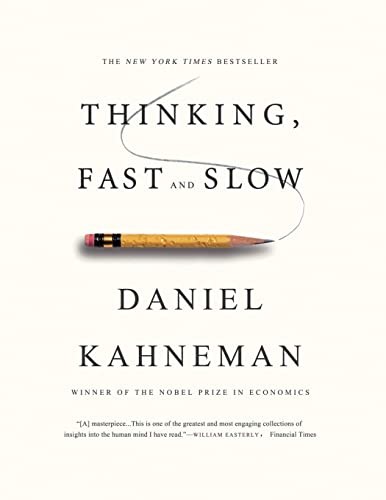
I picked this up mostly out of professional curiosity, then got pulled into it for entirely different reasons once I hit the chapters on loss aversion and started recognizing my own behavior at the game table embarrassingly clearly. Kahneman’s core split, System 1 as fast, intuitive, automatic judgment and System 2 as slow, effortful, deliberate reasoning, is one of those frameworks that seems almost too simple stated flatly and then turns out to explain an uncomfortable amount of actual human behavior once he starts walking through the decades of research behind it.
The prospect theory chapters, the work that actually won him the Nobel, are the strongest part of the book, the demonstration that people feel the pain of a loss roughly twice as intensely as the pleasure of an equivalent gain reframed a lot of my own instincts, why I’ll hold a losing position too long in a negotiation game rather than cut losses early, why a bad round in a co-op feels so much worse than a good round feels good. Reading that section, I kept mentally flagging specific games where I could see the bias playing out turn by turn.
The anchoring effects material, how an arbitrary number presented early can skew a completely unrelated judgment later, made me newly suspicious of every negotiation and every auction-mechanic board game I own, in a way I don’t think I’ll fully shake off now that I’ve seen the studies.
It’s a long book and some of the later chapters, particularly around the experiencing self versus the remembering self, feel less tightly argued than the earlier prospect theory material, more like extended reflections than the rigorous experimental grounding the first half builds up. A few of the original studies cited have also faced replication concerns since publication, worth knowing going in even though it doesn’t undercut the core framework much.
Dense, occasionally repetitive, but genuinely changed how I make decisions, at the table and off it. Four stars.