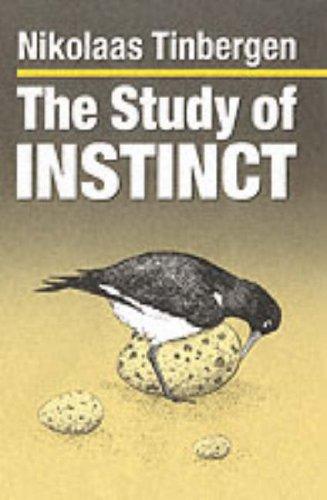
This is not a book I’d have picked up without a nudge, a 1951 foundational ethology text isn’t exactly what I reach for on a Friday night, but a friend who studies animal behavior professionally kept referencing Tinbergen’s four questions in conversation until I finally asked her to just lend me the source material, and I’m glad she did even though it took me considerably longer to get through than a book this length usually would.
Tinbergen’s framework, that any behavior can be understood through causation, development, evolutionary function, and phylogeny, four separate but complementary questions, sounds almost obvious once stated but apparently wasn’t standard thinking in the field before this book, and you can feel him building the case methodically, chapter by chapter, using his own field observations as evidence rather than pure theory.
The stickleback material is the part that stuck with me hardest, his descriptions of the fish’s mating display behavior, the zigzag dance, the red belly signal, and how he actually tested which specific stimuli triggered which specific responses using dummy models rather than just observing and guessing, is some of the clearest demonstration of the scientific method applied to animal behavior that I’ve read anywhere, textbook or otherwise. The herring gull chapters on the red spot on the parent’s beak that triggers chick begging behavior are almost as good, and I now genuinely cannot watch gulls at the beach the same way.
The prose is dry, this is a working scientist’s book from over seventy years ago, not written for a popular audience, and some of the terminology has since been revised or complicated by later ethology research, so it helps to read this as a historical foundation rather than current science.
Not for everyone, and it demands patience with mid-century academic prose. But as an origin point for a whole field of thinking about behavior, four stars, and I understand my friend’s references a lot better now.