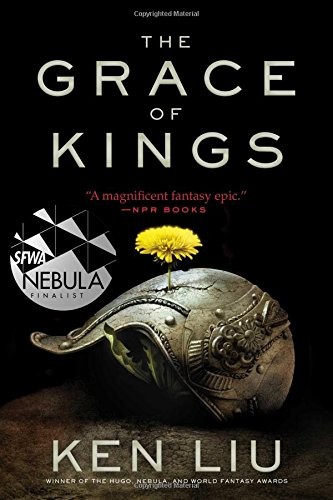
Ken Liu coined the term silkpunk for what he’s doing here and it’s not a marketing gimmick, this is genuinely a different technological and aesthetic vocabulary for epic fantasy, bamboo and silk airships instead of dragons, battle kites instead of cavalry charges, and it’s loosely reimagining the historical founding of the Han dynasty rather than pulling from the usual medieval-Europe toolkit that dominates the genre.
The two central figures, Kuni Garu and Mata Zyndu, are doing a classic rise-and-fall political drama, the clever pragmatic bandit-turned-strategist against the noble, honor-bound warrior, and Liu is clearly working in conversation with Chinese historical romance tradition, particularly Romance of the Three Kingdoms, more than Western epic fantasy structure. That shows in the pacing, which several readers I’ve talked to found jarring at first, the book moves in broad historical strokes, jumping years and battles in single paragraphs, rather than the slow scene-by-scene immersion a lot of fantasy readers are trained to expect.
I’ll admit it took me a solid hundred pages to stop fighting that pacing and just let the book be what it is, a mytho-historical chronicle more than a character-intimate novel, and once I did the sweep of it became genuinely thrilling, entire rebellions rising and collapsing, alliances shifting fast enough that I had to flip back to double check who was still loyal to whom.
The women in this first book get noticeably less interiority than Kuni and Mata, which Liu has openly said he corrects for significantly in the sequel, and reading book one in isolation that imbalance is a real, fair criticism, Jia and Gin Zheng have compelling moments but the narrative attention skews heavily male throughout.
An ambitious, structurally unusual epic that rewards patience. Four stars, and I’m already partway into book two to see how the promised course-correction plays out.